
Why Traceability in SAP Gets High Marks
April 17, 2020 | by Joshua Mc Mahon

Traceability is one of the most important aspects in many industries from food & beverage, to pharmaceuticals to consumer products and now the cannabis industry. SAP’s powerful reporting solutions and functionality allows you to trace your product from the raw components you purchase to producing your finished product and selling it to the customer and everything in between.
SAP ECC and SAP S/4HANA can assign and track items (materials) by a unique lot (referred to as a “batch number”) or serial number. Batch Master record stores different attributes like shelf life, expiration date and manufacturing date, supplier lot number, etc.
One of the key reports in SAP to handle Batch Traceability is the “Batch Cockpit” transaction, which allows you to perform Top-Down or Bottom-Up analysis to trace where batches are been received (created), consumed (production) and issued (shipped).
With the “Batch Cockpit” transaction, SAP allows you to quickly identify issues at your fingertips without extensive analysis. For example:
• Your QC team identifies a lot (batch) that contains a single allergen ingredient that was mistakenly added to the production batch
• Your raw components suppliers are performing a recall on one of the products they sold to you and you need to quickly react and understand where you have used/consumed the raw components in producing your finished product
• You need to perform a product recall and quickly identify, which customers you shipped the batch/lot of recalled product
• Your customer requests a full audit trail for a product that provides sourcing information for every component used in its production
THE KEY ASPECTS TO TRACEABILITY THROUGH THE ENTIRE SUPPLY CHAIN
Using batch and serial numbers, SAP provides information at the specific level required by your business. This can be as precise as the individual plant, tracked by serial number, to a production batch which can contain many different plants.

Beginning with procurement of tools, services and raw components, all item (materials) that are received into your system are assigned an individual serial or lot (batch) number. These will allow to keep track of exactly which raw components were used during the entire production process. If a problem would occur with one of the raw components used, SAP S/4HANA would be able to inform you of all production batches that may have been affected.
Quality inspection tasks can be generated against a particular production batch to record additional information for quality assurance purposes. Ex: recording inspection results and allowing for follow up actions (releasing stock, move to scrap, etc.). Once a product has been produced, the batch number will then follow through all subsequent actions.
TRACEABILITY IN INVENTORY AND WAREHOUSE MANAGEMENT
SAP’s inventory and warehouse management modules allow you to view the availability and exact location of all your products. From simple storage locations to complex racking systems, batch specific information is always available. Flexible picking and put away strategies can be defined based on batch characteristics (shelf life, receipt date for FIFO or LIFO, etc.).
Once the product has been picked for distribution, batch information will continue to flow through each step of the sales process. Starting with the handling units used for picking, packing and palletization, SAP allows you to control how batches are handled for distribution (Ex: No mixed batch packing), keeping track of exactly which batch is contained in which box or pallet.
END CUSTOMER TRACEABILITY FOR COMPLAINTS AND RECALLS
Once the product leaves your facility, all shipping and customer information will have been entered into SAP , which then be referenced if ever a problem would arise. A customer complaint could then be tracked back to a shipment, which delivered a specific pallet or box, which contained a production lot number for that material. Corrective action could then be taken against the batch by viewing the batch history information to track all remaining inventory, as well as all customers affected by this batch, all the way back to which plants had been used during initial production.
Batch Traceability is a key requirement in many industries. With SAP’s tightly integrated system and data capturing, you will more than exceed the requirements and standards in your industry.
About the Author

Joshua Mc Mahon
Related Articles
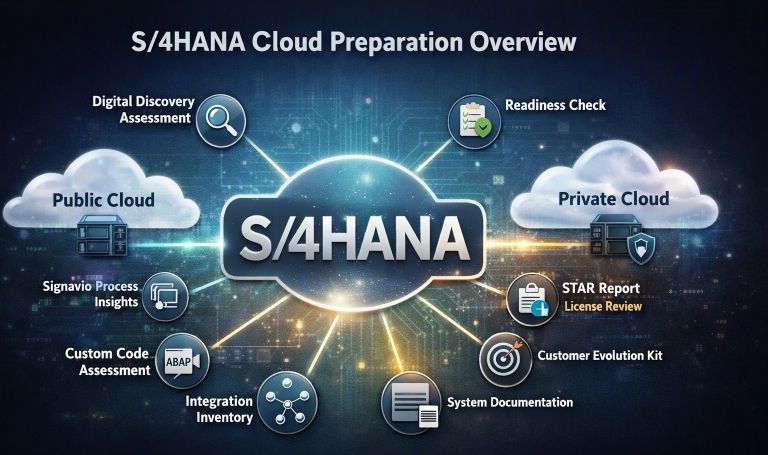
S/4HANA Public vs. Private Cloud — What ECC Customers Should Be Doing Now
A practical guide showing ECC customers the lowcost, highimpact steps they should begin now to ensure a smooth and wellprepared migration to S/4HANA Public or Private Cloud.

S/4HANA Public vs. Private Cloud — Understanding the True Cost Picture
The true cost dynamics of SAP S/4HANA Public vs. Private Cloud, and how subscription, implementation, and lifecycle factors shape longterm total cost of ownership.

S/4HANA Public vs. Private Cloud — Understanding the Fundamentals
A practical overview of the key differences between SAP S/4HANA Public Cloud and Private Cloud to help choose the right path forward.